Google

Startup

Selamat datang di webnya insinyur agak-agak tuli.
Terima kasih banyak Anda telah meluangkan waktu untuk berkunjung.

Rotating Engineer adalah titel profesi seorang insinyur teknik mesin dengan spesialisasi keahlian di bidang mesin-mesin berputar, misalnya turbin gas, kompresor sentrifugal, pompa sentrifugal, screw compressor, reciprocating engine, dan fin fan cooler. Seorang Rotating Engineer bertanggung jawab untuk membuat agar mesin-mesin itu dapat beroperasi dengan baik dan benar.

Blog ini berisi hal-hal yang berkaitan dengan profesi seorang Rotating Engineer. Isinya diambil dari pengalaman sehari-hari, berbagai sumber referensi, dan opini pribadi saya. Topik-topiknya dapat dilihat dengan meng-klik nama bulan yang ada di kotak "ARTIKEL" di sebelah kiri.

Diharapkan dari blog ini pembaca dapat mengambil manfaat yang sebanyak-banyaknya. Pertanyaan, diskusi, dan saran sangat saya harapkan. Bisa kontak ke saya di: rotatingengineer@gmail.com.

DISCLAIMER
Saya tidak bertanggung jawab atas segala akibat yang terjadi karena blog ini. Blog ini hanya berisi opini dan pengalaman pribadi saya saja.

Sekali lagi: terima kasih banyak.
wasalam


Tampilkan postingan dengan label engine. Tampilkan semua postingan

Jumat, 16 April 2010

Electric Turbocharger

Source:


What is Electric Boost?


Electric boost uses electrical energy to drive a compressor that provides additional air density to the engine, as opposed to using mechanical energy from the engine like traditional methods (belt driven superchargers or exhaust driven turbochargers).

Generating pressure by itself does not require much energy.
Example: The small tire pump you plug into your cigarette lighter is a compressor that uses very little electrical energy and can pump a tire up to 70 psi, but due to the devices low power draw, the small rate of air-flow coming from the straw-sized air-source requires over 10 minutes to pump a flat tire up to 35psi, and over an hour to reach 70 psi. Obviously useless if you placed this device on an engine intake as it would just create a massive restriction.

Generating air-flow by itself also does not require much energy.
Example: A radiator fan uses relatively little electrical energy, and can flow 400 to 700 CFM. However, just blowing air on something does not generate pressure, unless it there is both high air-flow rate AND air-speed. This is proven when one looks at how a "RAM-AIR" scoop works. A "RAM-AIR scoop only develops .07psi at 80 MPH, but can develop .38psi when the car is traveling at 180 MPH with a perfectly efficient ram-air scoop like the ones that are seen on Indy cars or above the hood of drag cars.

Generating air-flow AND pressure together DOES require a large amount of energy.
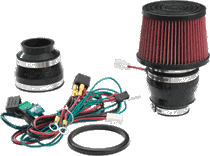
The e-RAM Axial-Flow Electric Supercharger:
The e-RAM Electric Supercharger produces on demand, the pressurizing effects greater than a perfectly designed ram-air system traveling at over 220 MPH, even when your car is standing still. To accomplish this, the e-RAM incorporates a custom high-power electric motor built specifically to our proprietary specifications, drawing over 830WATTS of electrical energy (1.2HP of electrical energy directly from the car battery) while running at a speed of 25,300rpm. We mate this up to a specially designed fully enclosed axial-flow fan unit that is desined much like a single stage of a jet turbine, incorporating tight enough tolerances between the fan blades and the internal walls to provide a high capability of air-flow with a mild pressure generating potential. When energized, the e-RAM tries to flow 800cfm into the intake, but since 2L engines only require 190 cfm at 6000 rpm, and 5.0L engines only require 470 CFM at 6000 rpm, it is the differential in airflow from what the e-RAM is trying to flow vs. what the engine is trying to take in that generates the positive pressure in the intake.
Since the e-RAM is 3.75" inside diameter, even with the motor in the center, it allows a free air-flow equivalent of a 3.1" diameter intake tube, so it does not create any restriction in the intake system when not energized during part-throttle conditions.

Centrifugal compressors are very good at generating pressure, but horribly inefficient at producing high rates of air-flow. Meanwhile, open axial-flow fans are very good at generating high rates of air-flow, but not great at generating pressure.

Generating pressure at air-flow rates required by an automotive engine takes a large amount of power. That is why "roots", "screw", and "centrifugal" compressors require between 15-20HP taken directly from the engine in order to generate just 5psi to 6psi on a small engine. Larger engines require even more HP to drive the compressor in order to generate this level of boost at the higher air-flow rates these engines require. The engine belts (or exhaust for turbos) must drive the compressor at a high enough rate of speed to generate enough air-flow so as to continually provide more air than the engine is trying to take in. Coupling the rotation of the compressor directly with the rotation of the engine allows the compressor to continue to generate pressure, even when the engine's requirement for air increases. Also, each 1psi that is added to the intake at these flow rates drastically increases the amount of power required to perform this task.

Driving a "roots", "screw", or "centrifugal" compressor electrically:
There are only two companies that we know of that manufacture "compressors" that are driven by electric motors. These are sound concepts, however, there are several drawbacks with these technologies:

One costs over $2000, and uses a "roots" style blower driven by three 6HP electric starter motors (18HP of electrical energy). This system uses belts that connect the motors to the compressor to run it at a high enough rpm to develop boost. Although almost 20psi of boost can be generated below 50 cfm, as the engine accellerates to higher rpms and requires higher air-flow, the amount of boost generated by the system drops dramatically (to roughly 5 psi at 300cfm). The 18HP of energy required to do this must come from a separate battery supply that weighs roughly 70lbs, and the compressor itself also carries a weight penalty of 25+ lbs. Since the power draw is coming directly from a separately charged battery supply, the entire system can only be used for a couple of drag runs before a waiting period must occur for the engines charging system to recharge the separate battery supply for future use. Add this to the need for a modified engine management system and fuel delivery system, and the costs, weight, and limited useability make a case for going with a traditional belt driven supercharger or exhaust driven turbocharger system.

The other system also costs over $2000 and uses a centrifugal "turbo" style compressor driven by a single 5hp electric motor. This system also uses a separate and heavy battery supply, but since it does not have as much power as the previous system, the boost level is much lower (3psi at 50cfm, and drops to less than 1psi at 200cfm, and 0psi at 300cfm). Due to the cost, complexity, and the boost provided, it too does not provide realistic performance gains that should be expected from such a costly system.

Regarding other "Electric boost" offerings like cheap plastic "turbo" looking devices or squirrel-cage ("leaf-blower" style) fans driven by a cheap electric motor:
Again, the concept of using an electrically driven "compressor" for boost is a sound concept, and again, the problem is that compressors are horrible at providing unrestricted air-flow unless they are constantly running at speeds that will also generate pressure. The "electric turbo" will have to be on all the time in order to not create restriction when not energized. This means it will have to use a low powered electric motor that won't draw any significant electrical energy so it won't overheat if used in constant duty.... thus... it won't draw enough electrical energy to generate any boost and will ultimately just restrict air-flow. Also, small plastic squirrel-cage fans cannot rotate at a high enough rate of speed to generate any pressure at flow rates required by a car engine. This is because the forces exerted on the unit if it were to rotate at a high enough speed to generate enough flow to produce pressure would cause the unit to self-destruct. It doesn't matter how powerful a motor is used with this type of cheap plastic fan.

Summary:
There is no "free lunch." Regardless of what PSI is claimed by ANY maker of electric boost technology, what hp gains are claimed, or at what rpms the "fan" is claimed to rotate, the laws of air-flow dynamics require a specific amount of power to generate psi at a given flow rate. Anyone claiming to do what we are doing [Axial-Flow (in-line) fan used to generate HP on an internal combustion engine] is IN VIOLATION OF OUR PATENT, and has no access to the motor technology required for this application.. Also, anyone else using any other style of "fan" based boost claiming ANY HP gains on a car engine without a power source of AT LEAST 680WATTS (48 amps at 13.88 Volts) is LYING, and just ripping people off.

Rabu, 16 Januari 2008

SAE Standard J1995

SAE Standard J1995

Date Published:
June 1995
Title:
Engine Power Test Code-Spark Ignition and Compression Ignition- Gross Power Rating
Issuing Committee:
Engine Power Test Code
Scope:
This SAE Standard has been adopted by SAE to specify:

a. A basis for gross engine power rating,
b. Reference inlet air and fuel supply test conditions,
c. A method for correcting observed power to reference conditions, and
d. A method for determining gross full load engine power with a dynamometer.
This test code document is applicable to both four- stroke and two-stroke spark ignition (SI) and compression ignition (CI) engines, naturally aspirated and pressure charged, with and without charge air cooling. This document does not apply to aircraft or marine engines. This test code supersedes those portions of SAE J1349 dealing with gross power rating. Standard CI diesel fuel specifications are range mean values for Type 2-D EPA test fuel per Title 40, Code of Federal Regulations, Part 86.1313-87. The corresponding test code for net power rating is SAE J1349. The document for mapping engine performance is SAE J1312.
ISO 2534 (1972) differs from SAE J1995 in several areas, among which are most important are:
a. This document is not limited to road vehicles;
b. This document requires inlet fuel temperature be controlled to 40 °C on CI engines;
c. This document includes a reference fuel specification and requires that engine power be corrected to that specification on all CI and certain SI engines;
d. This document includes a different procedure for testing engines with a laboratory charge air cooler (ISO method optional); and
e. This document includes a different procedure for correcting power to reference atmospheric conditions on turbocharged CI engines.
Complete correlation has not been established with ISO 3046. It is expected that this power test code will eventually align with ISO 1585 and ISO 2534.
trims

Jumat, 11 Januari 2008

Panduan Singkat Mencari Penyebab Kerusakan Mobil Bensin Berdasarkan Gejala yang Timbul (yg berhubungan dg fuel, emisi, & engine management system)

Troubleshooting mungkin dapat diartikan secara bebas sebagai mencari sebab permasalahan.
Berikut ini adalah panduan troubleshooting permasalahan pada mobil bensin berdasarkan gejala-gejala yang timbul. Panduan ini dibuat khusus untuk mobil yang memakai engine management system. Namun, bisa juga Anda gunakan untuk mobil-mobil konvensional sebagai panduan umum. Bedanya, mobil konvensional tidak memiliki sensor-sensor ataupun ada yang tidak memakai fuel injektor, melainkan memakai karburator.

MAP = Manifold Absolute Pressure
MAF = Manifold Air Flow
EGR = Exhaust Gas Regulator
TPS = Throttle Position Sensor
IAC = Idlespeed Control


Engine noise
- Hiss (bunyi mendesis) – vacuum leaks
- Adanya loncatan busur api atau Electrical arching (snapping noise)

Engine mau distart tetapi engine tidak mau hidup
- charcoal canister full of fuel
- faulty MAP, MAF, or coolant sensor or circuit
- EGR valve stuck open
- Faulty canister vent valve
- Fuel pressure lack
- Fuel empty
- Water in fuel
- Aki soak (putaran starter pelan/lemah)
- Busi kotor
- Severe vacuum leak
- Injektor mampet
- Sirkuit start rusak
- Faulty air flow sensor
- IAC valve defective

Engine sulit hidup – dingin
- Leaking injectors

Engine sulit hidup – panas
- Aki soak
- Air filter sumbat
- Defective coolant sensor/circuit
- Defective intake air temperature sensor/circuit
- Defective MAP or MAF
- Faulty TPS or circuit
- Aki kotor
- Ground jelek
- Busi kotor
- Fuel pressure
- Air flow sensor faulty
- PCV valve stuck open
- Vacuum/air leak

Engine hidup tetapi tidak mau jalan
- Faulty canister vent valve
- EGR stuck open
- Coil & alternator loose
- Intake manifold vacuum leaks
- Airflow kurang

Engine “lopes” idle, rough, erratic
- Air filter clogged
- Throttle plate/bore kotor
- EGR
- Vacuum leak
- Air leak in intake duct/manifold
- IAC
- Lean injector
- Rich injector
- Fuel pump
- Cold only = PCV stuk
- Warm only = TPS or MAF

Engine mati saat langsam/idle.
- Busi kotor/gap
- Kabel busi
- EGR valve
- Fuel filter/line
- Vacuum leak
- Incorrect timing
- Kompresi silinde low/sinjal

Excessive idle speed
- vacuum leak
- throttle linkage macet

Engine misses throughout driving speed range
- Fuel filter kotor
- Fuel pump pressure
- Busi
- Kabel busi
- Kompresi piston lemah
- Ignition system
- Vacuum leak
- Lean injector

Hesitation/stumbles/stalls kalau pedal gas diinjak/ditekan untuk akselerasi.
- Busi kotor
- Fuel filter
- TPS
- Air temperature sensor
- MAP
- Air leak di manifold
- MAF
- Throttle plate/bore kotor
- Ignition coil/kabel
- Fuel pump pressure
- Fuel injektor

Engine lack power/sluggish performance
- Air filter mampet
- Exhaust mampet
- Vacuum leak
- EGR valve stuck open
- MAP
- Busi gap
- Fuel filter
- Vacuum leak
- Injektor

Stall on decal/coming to a quick stop
- EGR valve stuck/leakage around base
- TPS
- Idle air control valve malfunction
- Fuel filter
- Gap busi
- Vacuum leak

Surging at steady speed
- Air filter
- Vacuum leak
- Air leak
- EGR valve stuck/leak at base
- O2 sensor
- TPS
- MAF, MAP
- Loose fuel injector connector
- TCC (torque converter connector)
- Fuel pressure, pump
- Lean injector
- Defective computer/information sensor

Engine tidak mau mati (diesel/runs on) saat kunci kontak di-off-kan atau idle speednya terlalu tinggi
- vacuum leak
- EGR Valve
- Excessive engine operation temperature, overheating
- Incorrect spark plug selection

Engine "nembak" /Back firing (baik dari intake dan/atau exhaust)
- vacuum leak di PCV or canister purgeline
- vacuum leak at fuel injector, intake manifold air control valve or vacuum line
- Faulty secondary ignition system (busi retak, kabel)
- EGR
- Emission control system
- Faulty air valve
- Valve clearance
- Damaged valve spring, sticking, burned check by vacuum gage

Bensin boros
- air filter mampet
- PCV
- O2 sensor
- Timing
- Fuel leak
- Injector worn/damage
- Rem mampet
- Ban kempes/kurang angin

Detonasi (spark knock)
- EGR valve inoperative
- Vacuum leak
- Busi
- Knck sensor
- Fuel quality

Exhaust banyak asapnya
- Black (rich): air filter, intake duct mampet, O2 sensor
- Blue (burning oil): PCV valve stuck, PCV filter
- Brown/yellow (lean): fuel filter, lean injector

Bau bensin
- tank overfilled
- tank cap gasket
- lines leaking
- injector stuck open
- injector leak internally
- injector leak externally
- EVAP canister filter in EEC mampet
- Vapor leaks from Evaporative Emission Control System lines


Beberapa Tools yang sangat baik untuk dimiliki karena akan sangat membantu dalam troubleshooting:

- stetoskop khusus otomotif (ujungnya yang ditempelkan berbentuk panjang seperti tubing, sedangkan yang punya dokter, yang ditempelkan berbentuk bulat)
- Analyzer
- Vacuum gage
- termometer laser
- timing light
- power cylinder pessure gage

trims